

Stirring & Heating Setup
Mixing and Temperature Control for Viscous and Reactive Samples
A laboratory mixer paired with a temperature-controlled bath or a heating mantle lets a sample be mixed and held at a set temperature at the same time. It is the standard configuration for dissolving solids, dispersing powders into liquids, and running reactions that need both agitation and heat.
What Is a Stirring & Heating Setup?
A stirring and heating setup brings a laboratory mixer and a temperature-controlled bath into one workstation. The stirring side keeps the sample in motion; the heating side holds it at a set temperature.
Which of these describes your sample?
Why Consistent Mixing & Temperature Matter
Inconsistent stirring or a drifting set point shows up as a failed batch long before it shows up in a spec sheet. Holding both steady is what makes a run repeatable.
Uniform Mixing
Uneven mixing leaves concentration gradients inside the vessel, so the reaction runs at a different rate in different places.
Temperature Uniformity
A bath that is not circulating develops a difference between the sensor position and the rest of the vessel.
Process Stability
Steady agitation and a held set point keep the run inside its window instead of drifting toward a rework.
Reproducibility
A fixed stirrer speed and a stable set point are what make run-to-run results comparable.
Key Selection Factors
Four factors decide which stirrer and which heating method a setup needs. Work through them in this order before comparing models.
Sample Viscosity
Thin liquids run on a magnetic stirrer; pastes, gels and resins need an overhead motor with enough torque to keep the whole volume moving.
Vessel Volume
Working volume sets the shaft length and impeller diameter. A shaft that does not reach the bottom leaves a dead zone no matter how fast it turns.
Target Temperature
Below 100°C a water bath covers most work; above it an oil bath holds the set point. Round-bottom flasks are heated directly in a mantle.
Mixing Speed & Torque
Speed alone does not indicate mixing power. Check the torque range against the viscosity at the end of the run, not at the start.
Recommended Stirring & Heating Workflow
A typical mixing and heating run follows four steps. The choices made in the first three determine what the run can do.
Define the Sample
Note the viscosity at working temperature, the working volume and the highest temperature the run needs. These three values decide everything that follows.
Select the Stirring Method
Magnetic for thin, low-volume samples; a laboratory mixer with a shaft for viscous or larger volumes. Match the impeller to the job — propeller for low viscosity, paddle or anchor for high.
Select the Heating Method
Water bath below 100°C, oil bath above it, heating mantle for round-bottom flasks, or an integrated stirring bath when both functions are wanted in one unit.
Set and Monitor
Bring the bath to the set point before immersing the vessel, start stirring low and raise it in steps, and watch for a viscosity rise as the run proceeds.
Recommended Equipment
This setup has two sides. The laboratory mixer provides the mixing; the heating side provides the temperature. Most laboratories need both, and either can be the starting point depending on the sample.
Overhead Stirrer
Provides the mixing. Chosen when viscosity, torque demand or working volume make a magnetic bar inadequate.
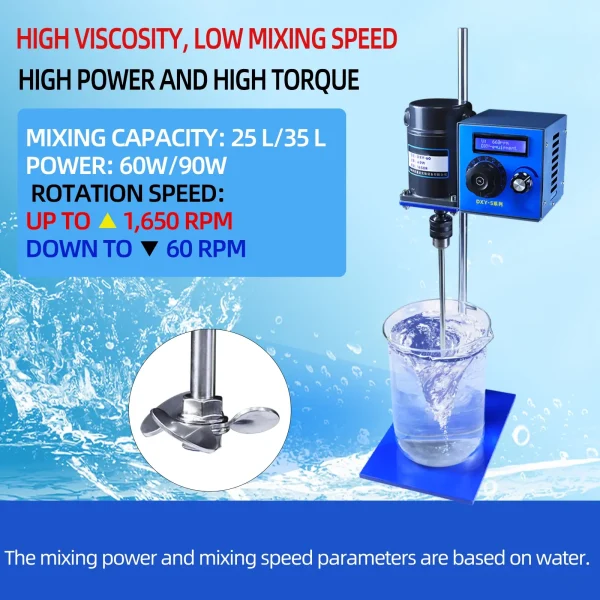
Xin Tester High-Power Overhead Stirrer, 60W-200W Digital Lab Mixer with Timer & 304 SS Paddle (25L-70L) DXY Series

Oil Bath
Provides the temperature. Holds a set point above what a water bath can reach, for reactions and dissolution that need sustained heat.
Xin Tester Split-Type Oil Bath with Timer, 350°C Digital Constant Temp Heater (1 to 6 Holes)

Why This Configuration?
One Workstation, Two Functions
Mixing and temperature control come from two units that can be specified, replaced or upgraded independently.
Heating Options That Match the Vessel
A splash-proof oil bath for beakers and flasks, a heating mantle for round-bottom flasks, or an integrated stirring bath when one unit is preferred.
Stirring Independent of Heating
The stirrer and the heat source are separate, so the mixing method can change without touching the temperature setup — and the reverse.
Standard Laboratory Integration
Both units use standard vessel sizes and power supplies already found in most laboratories.
Typical Applications
Stirring and heating together cover a wide span of routine laboratory work. The four areas below are the most common day-to-day cases.
Dissolving Solids
A powder or crystalline solid is added to a solvent and held at temperature while stirred, so it dissolves fully instead of settling at the bottom. Typical for salt solutions, buffers and reagent stocks.
Dispersing Powders into Liquids
Pigments, fillers or ceramic powders are worked into a liquid carrier under continuous agitation. The viscosity rises as the solid loads up, which is why a laboratory mixer is used rather than a magnetic bar.
Heating & Mixing Viscous Samples
Resins, pastes, gels and polymer solutions resist a magnetic bar because it cannot couple through a thick medium. An overhead motor with a suitable impeller keeps the whole volume moving.
Temperature-Controlled Reactions
Reactions that need a held set point for a defined time — precipitation, hydrolysis, saponification — run with the vessel in a bath while the stirrer maintains contact between the phases.
Suitable Materials for Stirring & Heating

Featured Equipment: Overhead Stirrer
A laboratory mixer drives a shaft and impeller directly into the vessel, so it keeps viscous samples moving where a magnetic bar cannot. Selecting the right power rating and impeller lets the same unit handle thin solutions and thick pastes as long as the shaft reaches the full volume.
- Handles viscous samples a magnetic bar cannot
- 60W–200W digital speed control
- Interchangeable impellers and shafts
- Runs with the vessel in a heating bath
- Research and quality control applications
Before You Buy an Overhead Stirrer
Match the laboratory mixer rating to the viscosity at the end of the run, not the start. Thin liquids sit at the low end of the 60W–200W range; pastes and gels need the upper end.
Working volume sets the shaft length and the impeller diameter. Confirm the shaft reaches the bottom of the vessel with the impeller in place.
Low-viscosity mixing needs speed; high-viscosity mixing needs torque. Check both figures rather than the maximum rpm alone.
Stirring & Heating FAQ
A magnetic stirrer drives a bar from below the vessel and suits thin, low-volume samples. An overhead stirrer drives a shaft from above and handles higher viscosity and larger volumes.
Use an oil bath when the set point goes above what water can hold at atmospheric pressure, or when the run is long enough that evaporation from an open water bath becomes a problem.
Yes. The common arrangement is a laboratory mixer with the vessel sitting in a bath, which keeps the two functions independently adjustable. An integrated stirring bath does the same job in a single unit.
A mantle is sized to a round-bottom flask and heats the flask directly. A stirring bath takes beakers and flasks and adds magnetic stirring in the same footprint. Choose by vessel shape first.
Start low and increase in steps. Beginning at full speed with a viscous sample can stall the motor, throw the vessel, or splash material up the walls of the container.
Need a Stirring & Heating Setup for Your Application?
Xin Tester supplies laboratory mixers, overhead stirrers, magnetic stirrers, water and oil baths and heating mantles for laboratory mixing and temperature control.