

How to Choose the Correct Test Sieve — 6–40 cm Frames
A wrong sieve invalidates a whole batch of results. Fix the frame by sample volume first, then the mesh by wet or dry method, then the material by standard — three steps, right every time.
All stacks rated to ASTM E11 / ISO 3310-1 · Full 6–40 cm frame range in stock
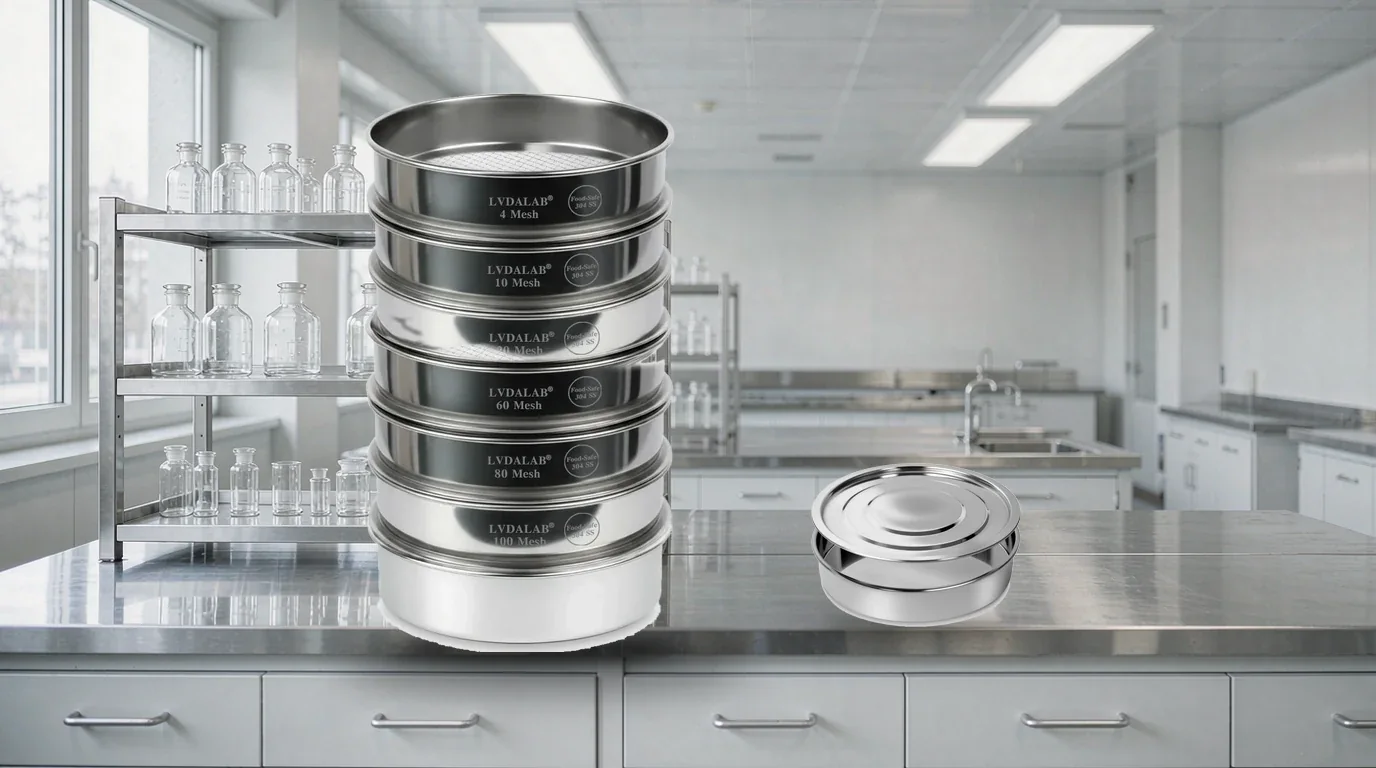
What a Compliant Sieve Stack Includes
Lid, frame, mesh and pan stack in a fixed order; get the order wrong and fines are trapped in the coarse layers — the whole set of results is void.
01
Lid
Holds the top sieve down and prevents sample loss during agitation.
→
02
Frame + Mesh
Stack sieves coarse-to-fine; each layer retains its own fraction.
→
03
Pan
Collects the fraction passing the finest sieve — essential for mass balance.
→
04
Agitation
Hand-shake or any existing lab shaker; stack diameters are universal.
One Compliant Set
Lid, frames, mesh and pan share the same diameter — stack and go; data goes straight into the report.
ASTM E11 · ISO 3310-1 · GB/T 6003.1
What Invalidates a Sieve Analysis
A sieve is a measuring instrument, not a consumable. Cross these lines once and the apertures are no longer trustworthy.
A Sieve Is a Gauge, Not a Consumable
Cross any of these four lines once and the aperture is no longer credible — invalid data usually starts with one out-of-spec sieve.
Acceptance basis · ASTM E11 / ISO 3310-1 / GB/T 6003.1
Certification
Out-of-spec aperture = rejection
Sieves used for reports must be accepted to ASTM E11 / ISO 3310-1 / GB/T 6003.1; uncertified apertures are for rough sizing only.
Cleaning taboos
No stiff brushes, no long soaking
Stiff brushes and ultrasonics deform the apertures; wipe dry immediately after wet sieving — a soaked 430 frame will rust.
Usage limits
Every material has a ceiling
High temperature, corrosive samples and hard particles each stress mesh and frame differently; crossing the limit permanently changes the aperture.
Replacement
Deformed = retired
Replace the mesh the moment it shows visible deformation, holes or clogging that will not regenerate — never report data from it again.
Selection Decision Order
Sample volume → wet or dry → material → standard. Decide in this order before comparing models; a wrong first step skews everything after it.
01
Sample volume sets the frame
Small powder samples: 10–20 cm; aggregate and soil gradation: 30–40 cm. If one charge exceeds 1/3 of the mesh surface, move to a larger frame.
02
Wet or dry sets the method
Agglomerating, moist or slurryable samples go wet; free-flowing dry powders stay dry. The method fixes the mesh floor and the cleaning routine.
03
Material sets the frame
All-304 for corrosion resistance and certifiable reports; 430 frame + 304 mesh for budget; nylon mesh + PVC frame to avoid metal-ion contamination.
04
Standard sets acceptance
External reports: accept to ASTM E11 or ISO 3310-1; internal QC can use GB/T 6003.1. Confirm the certification basis before you buy.
Three Frame Materials, Three Buying Logics
Same spec sheet, three completely different trade-offs. Choose by sample nature, not by price.
All-304 Stainless Steel
Mesh and frame both 304
Corrosion-resistant, wet-sievable and report-certifiable. The workhorse series for coffee grinding, flour and grain, and liquid filtration.
430 Frame + 304 Mesh
Precision mesh, economy frame
The 304 mesh keeps aperture accuracy while the 430 steel frame cuts the cost of the set. Best value for routine dry powders; avoid long soaking.
Nylon Mesh + PVC Frame
Zero metal contact
No metal anywhere in the set — ideal for batches sensitive to metal ions; light and easy to wash, with limited precision and temperature range.
Mesh-to-Micron Conversion Chart
Consolidated from the official LVDALAB Size Chart (3–140 mesh); higher mesh number = smaller aperture = finer retention.
Note: the two product series differ by up to ±0.3 mm at 4 / 6 / 8 / 12–20 / 140 mesh; values here are unified to ASTM E11. Finer meshes (180–500) are available on request.
Three Ready-Made Sieve Sets
Skip piece-by-piece assembly — pick a set with one consistent diameter that stacks and works out of the box.
STARTER
Starter Sieve Set
20 cm all-304 sieve + pan + lid covers everyday dry sieving. The minimum viable configuration for a first setup.
View Starter Kit →
STANDARD
Standard Sieve Stack
Multi-layer sieves with pan and lid as a matched set, covering the common mesh ranges. The everyday configuration for QC batch checks and incoming inspection.
View Standard Kit →
PRO LAB
Pro Lab Gradation Set
Large frames + fine-mesh range + spare meshes, built for full particle-size distribution reports and higher batch throughput.
View Pro Lab Kit →
Typical Applications & Suggested Mesh
Four separation behaviors, four different logics; mesh suggestions follow the official LVDALAB application chart.
Metal Powder Recovery
Cut-point control and powder capture: size 40–140 mesh by powder particle diameter; all-304 mesh withstands powder impact.
40–140 mesh
Static & Sensitive Powders
Nylon mesh + PVC frame means zero metal contact — ideal for pharmaceutical and mask powders sensitive to metal ions.
40–120 mesh
Coffee & Food Grinding
Grind size drives extraction consistency: the routine control band for coffee, flour, grains and spice powders.
20–120 mesh
Aggregate & Soil Gradation
Large samples go into 30/40 cm heavy frames; coarse fractions are graded per your method standard.
3–40 mesh
Common samples → suggested mesh (from the official application chart)
Boundaries & FAQs
Most wrong purchases happen on these four boundaries. Confirm them first, then pick your sieve.
How much sample should I load per charge?
Never load above one third of the mesh surface height; an overloaded mesh traps fines before they reach the surface and biases results coarse.
When is sieving complete?
Per ISO 2591-1: the endpoint is reached when less than 0.1% of the remaining sample passes in one minute of continuous agitation.
All-304 or 430 frame — how do I choose?
Choose all-304 for reports, wet sieving or corrosive samples; for routine dry powders on a budget, a 430 frame with a 304 mesh is the best value.
Any precautions when sieving liquids?
Wipe dry immediately after use and avoid long soaking — 430 frames rust, and nylon mesh relaxes and deforms when left in water.
Bring This Sieve Set Into Your Lab
Tell us your sample and target mesh — our engineers will match frame size, material and standard in one go.